- New and better layout.
- Full color book.
- Rules clarifications.
- Correction of all Cepheus Deluxe errata.
- Many more, high-quality, full color illustrations.
- Deck plans for all thirteen included star ships!
Get the new book HERE!
![]() |
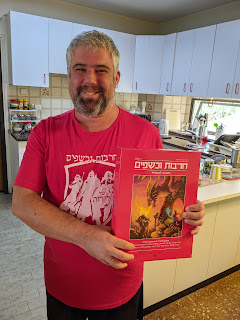
| Yours truly holding the Beginner Kit and wearing the local Swords & Wizardry T-Shirt |
Afterwards came Lamentations of the Flame Princess; the Adventurer, Conqueror, King System (ACKS), a short bout of Swords & Wizardry: White Box, and, finally, settling on Old School Essentials (OSE) as my go-to fantasy RPG. However, things have changed recently, and I am returning to Swords & Wizardry!
The reason is that Swords & Wizardry is enjoying rapid growth here in Israel. After the core book was translated in the previous decade, a local team gathered and created an actual Beginner Kit boxed set! This costs 99 NIS (approx. $30 USD) and includes all the rules necessary to play the game up to level 5, as well as dice and two adventures! This Kit is now sold in multiple game, toy, and book stores across Israel, ready to bring new players and Game Masters into our hobby!
![]() |
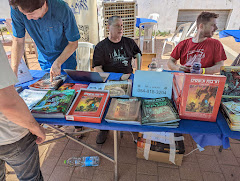
| Swords & Wizardry booth at a local convention, with a wealth of new products! |
This opened the floodgate to a burgeoning ecosystem of supporting books, especially adventures, put forth both by the local translation team, and by third parties. This happens while D&D 5E is unavailable in Hebrew (other than its mostly-unformatted SRD) due to licensing issues. While most adult Israelis know English relatively well, children are rarely fluent in it, and even many adults prefer to run and play games in our native tongue. So, the game is growing exponentially here!
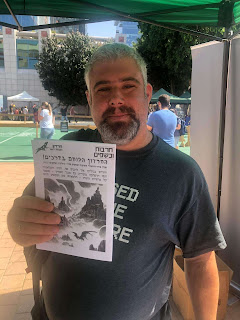
I am also behind the local (Hebrew) Swords & Wizardry fanzine, the Fighting Agama, which already published two issues, and a third one is already in the works - this is intended to be a bi-monthly, or maybe even later monthly, publication.
![]() |
| The Fighting Agama fanzine! |
Disclaimer: The Hebrew version of Swords & Wizardry is based on Swords & Wizardry: Core by Matthew J. Finch (https://swordsandwizardry.com/). The translation was performed by Itai Greif, Michael Gorodin, Eran Aviram, Itai Horev, and Eran Ben-Saar. the local team is unaffiliated with Frog God Games or Mythmere Games.
Also note that I have not been personally involved in the Beginner Kit's development, though I backed it on local crowdfunding, but I am involved in the upcoming Expert's Kit development.
![]() |
| Emblem of the Solar Union |
A post-apocalyptic Classic Traveller setting I am thinking about is as follows, briefly, as a more elaborate and less standard replacement for Harsh Beginnings:
What do you think?
![]() |
| Image (c) MaksTRV www.fotosearch.com |
I wanted for some time to create a side "pet project" free/Fair Use setting using 3-book Classic Traveller. I wanted something strictly non-OTU, so this means writing something which is not Dark Nebula.
I have tried consolidating concepts for my Post-Imperial setting. Still no clear line of thought, only various ideas. Instead, I will focus on my near future/near Earth setting. Hardcore Classic Traveller at TL9, with the only deviation from the rules being using custom world generation based on colonization wave.
This should have a very different tone from my older Hard Space setting concept. Neither "true" hard science, nor chrome-focused cyberpunk. Instead, it will detail a harsh future inspired by the near-future sci-fi novels and other media I consumed in the 1990's, which was mostly from the 1960's, 1970's, and 1980's.
Niven's Known Space tales set prior to Kzin contact; Arthur C. Clarke's stories; Roadside Picnic; Alien(s); Outland. This will be somewhat less industrial and less hard sci-fi than Zozer's HOSTILE, though.
Ground Rules
Maps coming soon.
Classic Traveller's Book 1: Characters and Combat provides a surprisingly complete collection of low-tech arms. Weaponry includes a good range of TL0-3 weapons, from spears to muskets, ideal for low-tech lost colonies and to forays into medieval and fantasy role-playing. Furthermore, Supplement 4: Citizens of the Imperium provides bows and crossbows, including the inaccurate but rapidly firing Repeating Crossbow. Book 3: Worlds and Adventures also provides common adventuring gear, such as torches.
Elven Chain, TL1, Cr2000. A suit of particularly high-quality and lightweight Chain armor. Treat as
Mesh-1, weighing only 8000 grams. At the Referee's option, it may even count as regular Mesh against modern (TL3+) weapons.
Note that, in the setting postulated in Traveller's Three Black Books, especially in their 1977 edition, star travel is infrequent, dangerous, and expensive.
A parsec's passage in cold sleep (with its 15% mortality rate!) is Cr1,000. Traveller Credits are said to be $3 each in 2020-or-so real-world USD (prior to the current wave of inflation). So, $3,000 just to travel, at a risk to your life, to a neighboring world. Crossing the subsector (8 parsecs) would cost you $24,000. One way. In dangerous cold sleep.
Normal "Mid Passage" without the risks of cold sleep costs $24,000 per parsec. Crossing the subsector will cost $192,000.
Add to that the risks of engine failure and/or "misjump" of the ship you are riding even when in "safe" Mid Passage. And frequent piracy. And hijacking (ships are worth a lot, so thieves abound).
People don't travel casually.
PCs are Travellers - belonging to the small class of people who actually travel frequently, be that thanks to wealth/Travellers' Aid Society membership, or due to having a job on a starship. Most NPCs stay on their homeworld.
Also, the average (and approximately median) world has hundreds of thousands of residents. The average world, isolated by the dark gulfs of space, has the population of a small city.
Worlds with billions of residents are rare, and, if their tech level permits, are often local hegemons. This has interesting implications to interstellar warfare. First of all, given ship size and availability, expect even large planetary invasions to be the equivalent of the Third Battle of Cartagena rather than of D-Day. Second, as world populations are typically small, a reasonably-sized mercenary unit can often have local military significance.
That's Classic Traveller as written originally. Within a few years, it evolved and changed into a more "open" space-opera setting, with various unified task systems and with a grander, less isolated setting. Passage costs remained high, but starships grew, and the setting changed from one or two subsectors rolled by the Referee to the vast Imperium.
My own Cepheus Deluxe books and settings were inspired by these later mechanics, while trying to preserve some of the original spirit. But they are quite different from the original form of Traveller. If I were to write an OSR book in the spirit of such original, it would have looked quite different from Cepheus Deluxe.
![]() |
| Art by LadyofHats |
In the Knave spirit, I keep these rules to a bare minimum. Each species has an Ability Score requirement, an edge, and a flaw. This may seem somewhat minor in scope compared, say, to the OSE treatment of such creatures. However, once again, this is Knave, and Knaves tread lightly.
Below is a tentative list of species I may permit in my Knave campaigns:
Dwarf: minimum Constitution Defense of 13. Advantage on any roll related to construction or mining and searching for secret doors. Base speed is 30' rather than 40'.
Elf: minimum Charisma Defense of 13. Advantage on stealth rolls in natural surroundings. Suffer a -10% penalty to XP.
Geckofolk: minimum Dexterity Defense of 13. May effortlessly walk on walls; may walk on ceilings at half speed. May not use two-handed weapons due to size; may not climb or cling when wearing boots or gauntlets.
Gnome: minimum Intelligence Defense of 13. Knows one level 1 illusion spell - chosen one the player - requiring no inventory slot, which they may cast once a day per 2 levels of experience (e.g., a level 4 gnome can cast it twice). May not use two-handed weapons due to size.
Halfling: minimum Dexterity Defense of 13. Advantage on throws to pick pockets and other tricks of sleight of hand. Consumes twice as much food a day than other species.
Human: no Ability Score requirements. Neither an advantage nor a disadvantage. Default species.
Insectoid: minimum Dexterity Defense of 13. Immune, poison, disease, and ghoul paralysis. Disadvantage to any social rolls (other than intimidation) with other species.
Lizardfolk: minimum Strength Defense of 13. May hold breath for 10 minutes and swim effortlessly at 40' per round. May not wear helmets or boots designed for other species due to different morphology.
Orc: minimum Strength Defense of 13. May become enraged once per encounter, granting an advantage to Attack Rolls for 1d6 rounds. Disadvantage to any social rolls (other than intimidation) with other species.