Showing posts with label BFRPG. Show all posts

Thursday, September 28, 2023

Your OSR Setting is a Deathworld

 
Art by Cristian Ibarra Santillan; used under CC license

Your OSR setting is a deathworld. This may not seem obvious - indeed, many settings appear to have an expansive and relatively safe countryside - but an examination of the encounter tables and monster descriptions of popular Old School Revolution (OSR) games speaks otherwise.

A "deathworld" is a term popularized (or maybe coined) by the Warhammer 40K universe. It refers to a world which is inimical to Humanity, be that due to climate, atmosphere, or biosphere. Such worlds require a major effort to survive on, and, in Warhammer 40K, typically breed elite warriors forged by the world's overall hostility.

Encounter tables in various OSR games, if you examine their implications, depict a world not unlike these deathworlds. Even in the perfect fantasy environment, with a temperate climate and pleasant terrain, monsters abound. Not just wolves and goblins, but rather dragons, powerful undead, owlbears, and worse. A sea journey may even be interrupted by a dragon turtle or a kraken - monsters sometimes above the ability of even "Name Level" (level 9) characters to fight without specialized tactics, or even with them.

The encounter tables are laden with powerful monsters. In OSE, for example, on pp.218-222 of the Roles Tome, the encounter tables depict a frightening world. There is a 1-in-8 (!) chance, for example, to encounter a dragon in most biomes, always a tough encounter for characters of any level. While some dragons may be reasoned with, many of these regal beasts would demand tribute, or simply try to eat whomever they encounter. Lycanthropes are common, as are undead, including powerful mummies and vampires. In ACKS, tables are similar to those in OSE, with a 1-in-8 risk of a dragon and a major piracy risk (yarr!) in the high seas. In the Basic Fantasy RPG, 4th Edition, pp.180-181, dragons are a somewhat less common (only encountered on the results of 2 and 16 on 2d8), but still an extant threat in almost all biomes. Giants and rocs in the mountains and giant octopi in the sea are more common.

Note that neither ruleset has a "safe countryside" column. Even ACKS's "Inhabited" column has a dragon in it! It's either cities, with their own criminal and undead problems, or the deadly Wilderness!

Anything PCs can encounter, villagers and even sedentary villages will encounter often. Even if you reduce the encounter rate in "Civilized" areas to once a month, on the long run, dragons, giants, and other monsters will come to your village to raze it or demand tribute. Goblinoid tribes will raid villages on a frequent basis. It's a dangerous world out there! Not your idyllic fantasy countryside. Not the Lord of the Rings Shire, where danger is a rare occasion worthy of an epic saga. It's closer to Catachan of Warhammer 40K fame!

And add to that monsters outside the encounter tables, but present in your typical OSR ruleset's Monsters chapter, such as Cloud Giants in their flying castles.

The implications are numerous:

  • The default setting, given the encounter tables and monster chapters, would be Points of Light. That is, most of the world is deadly, and Humanity huddles around the few safer spots - typically city-states as noted below. Outside these safer points - the world is out to get you.
  • It is likely that the setting is post-apocalyptic, with a strong Gamma World vibe to it. Maybe the past was safer, with a mighty empire keeping the monsters at bay. Maybe even most monsters did not exist before the apocalyptic event.
  • A dispersed population would be at much greater risk than a concentrated settlement pattern. Defending disparate villages is much harden than defending a walled city-state and its adjacent farmland. Thus, settlement pattern will be closer to that depicted in sword & sorcery literature, namely city-states rather than vast expanses of countryside.
  • There is a reason Name Level - when characters can become "proper" lords - is at Level 9. Below that, the local lord would be hard pressed to defend his protection ra---- sorry, feudal domain - from roving monsters and humanoid hordes. But even then, remote villages ruled by high-level characters would still be at greater risk than the city-states, with their high concentration of name-level characters, strong walls, and the ability to raise large armies.
  • Personal power would equal political power - the ability to defend one's turf against monsters and usurpers.
  • Outside Civilized territory, monsters will form their own domains. A dragon may be worshiped as a protective deity, sometimes enjoying human sacrifices from its subjects. A powerful undead monster may be able to carve a domain of death or even construct a necropolis around it. Humanoid tribes are also affected by this - they will often be at the bottom of the monstrous food chain, giving tribute to more powerful monsters, and sometimes serving them as cannon fodder.
So, expect a Points of Light setting with a concentrated settlement pattern, mighty city-states, and a vast, deadly wilderness challenging adventurers seeking danger, glory, and wealth.

Saturday, March 12, 2022

If it fights like a human bandit...

 
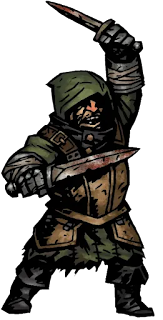
Bandits! Illustration taken
from Darkest Dungeon


I am in the process of designing the monster supplement for Barbaric!, Stellagama Publishing's lightweight sword & sorcery RPG ruleset. This got me thinking about, well, fantasy monsters, their presentation, and their use in a role-playing campaign. In short, monsters need a purpose and a unique "feel". Why? Because once you play traditional fantasy RPGs for many years, you eventually grow tired of creatures who only have hit points, a to-hit roll, saving throws, and damage; creatures who simply rush forward and hack and slash the player characters.

So, I posit the following design rule: if it fights like a human bandit, it should be a human bandit. Where "bandit" may be replaced by any level 0 (or level 1 fighter) human. Mind you, this is not a philosophical proposition about humans being the true monsters, or anything similar. Rather, it means that for a monster to be a monster, it should be differentiated from normal humans, including in mechanical terms.

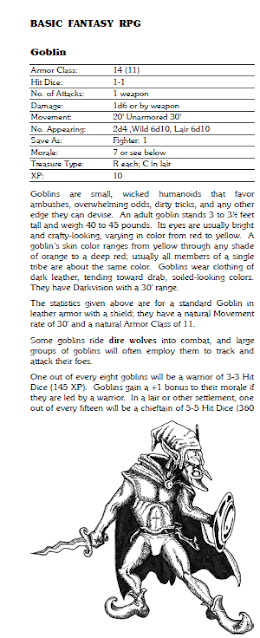
Hobgoblins, and in some cases orcs and goblins as well, tend to suffer from this problem. Sure, they look different from human bandits, but mechanically they are like human bandits, and often in description as well - other than being green-skinned or hog-snouted. Take, for example, the Goblin from BFRPG: It has AC 14, 1-1 HD, attacks and damage by weapon, and saves as a level 1 fighter.


Sure, they use "ambushes and overwhelming odds" to gain an edge over their enemies. But so do wise bandits. They do sometimes ride dire wolves into combat, which does add a certain level of uniqueness. But still, they lack significant uniqueness, especially mechanically speaking. Interestingly, maybe ironically, D&D 5E makes an interesting step in the right direction:

Nimble Escape. The goblin can take the Disengage or Hide action as a bonus action on each of its turns.

Now, mechanically, they can do something a goblin cannot, i.e., avoid "parting shots" ("Attacks of Opportunity" in modern D&D parlance) and hide without expending their combat action. However, other D&D 5E monsters do not always have such design choice and have special abilities which simply add damage.

Potentially, I'd add a description of a change in tactics between goblins operating on their own and those bullied into better fighting shape by a stronger creature. Alone, I'd give them low Morale and hit and run tactics. When bullied, they will be less likely to scatter when encountering a tougher foe and may use their stealth abilities more thoroughly.

Also, imagine Froglings. Another 1-1 HD monster in my version of them. However, they do gain two additional abilities:

  • In a swampy terrain, they enjoy an increased chance for surprise, and, potentially, good concealment (like Elves in a forest).
  • They may leap. This means jumping up to 3m high and 6m far. Just imagine the challenge to players, when the Frogling ambushers simply jump over their well-crafted phalanx to attack them in the back...
So, make monsters unique and interesting. They are monsters for a reason - they have strange and, well, monstrous abilities.

Tuesday, January 26, 2016

Effective use of Lethality in Old-School RPGs

A few days ago I wrote about lethality in older-school RPGs. Many responses were enthusiastic; other correctly criticized my post regarding arbitrary as opposed to non-arbitrary death; after all, "gotcha" death usually sucks in RPGs, and if the Referee just wants to kill the PCs, he could always bury them in a landslide or under a collapsing ceiling. This, of course, will be no fun. So I am obliged to further elaborate regarding the use of lethality and Save-or-Die elements in older-schools role-playing games.

Lethality should always be the result of a choice. An informed choice, at least to a certain degree. As I've noted above, and as obvious to any good player or Referee, "gotcha" lethality is not very enjoyable. A Save-or-Die situation should arise as a result of a player choice. Taking risks sometimes warrants an immediate risk of death. For example, if you choose to go toe to toe with a venomous snake, you take the risk of getting bitten, which may be fatal. Typically, a good Referee will describe a snake or, at least, hint at its existence. If you choose to ignore the warning and take the risk, you can definitely face death. After all, venomous snakes are scary for a reason - many of them can kill you. A dead king's tomb still containing treasure after centuries of potential grave-robbers is bound to be trapped to the hilt, and its exploration warrants great care and many precautions. If you take the risk and rush your exploration of such a dungeon, a trap may kill you. There should always be a chance to avoid the trap by player skill and attention to details. But deadly traps in such tombs are part of the adventure genre. If you choose to drink a mysterious potion found in an underground temple of Chaos, you risk being poisoned or worse. If you enter the dungeon corridor strewn with many human bones and skulls of possible victims of a horrible monster - you might actually encounter the monster itself, and you risk turning into yet another pile of bones in the corridor. If you enter the curious garden of strange statues, you might face the Medusa - capable of turning you to stone with a single gaze.

The thing common to all of these cases is that there is a warning before the decision to take the risk or avoid it. Either an explicit warning, such as the town's elders speaking in hushes whispers about the horrors of a haunted tomb, an environmental cue such as bones of former victims or the petrified victims of the Medusa, or a risk known to common sense such as the notion that strange liquids in deep chapels of Chaos might have negative effects on you or the basic fact that venomous snakes might kill you with a bite. Taking the risk is a player's choice, and typically holds a potential reward. A pile of gold under the slithering snakes, rumors of great treasures guarded by the Medusa, stories of potions holding wondrous effects on their imbibers. If you wish to reduce risk, you also reduce the reward in many cases. You wish a big reward - you'll have to take risks.

The same goes in Traveller. In character generation, if you choose to be a Marine, you should be tough as nails - as a Marine should be, or you face a high risk of death in the line of duty. Even if you're tough, Marines are people who get kicked out of a starship in orbit and told: "conquer that planet!". This is badass, but very, very risky, especially in times of war. The reward is first the badass title of a Star Marine, and also all manners of combat skills, easy retention and relatively easy promotion. Scouts are more extreme - you die easily in the line of duty just like Marines, because you go into the Unknown and the Unknown has teeth, claws, and tentacles, but you may receive the ultimate reward - a free starship of your own! A clever character entering the Merchant Marine risks a far lower risk of death, but if you do gain a starship, it has a heavy mortgage attached. You can try and save hard-earned Credits by travelling in Low Passage, but you risk Low Berth failure and death. You can try and save on expensive refined fuel by doing frontier refuelling, but unrefined fuel can do bad things to the delicate and finicky civilian systems of your Free Trader.

Risk and reward, accompanied by at least some hint regarding the risk and reward at hand, are key to enjoyable death threats in older-school RPGs. This could add much tension, excitement and thrill to your game of handled right. This is why Save-or-Die effects are so useful in such games.

Sunday, January 24, 2016

In praise of lethality in old-school RPGs


A common complaint about older-school role-playing games (RPGs) is that they are highly lethal and, as the complaint goes "unduly and arbitrarily punish characters and players". And indeed, many newer-school players view such lethality in disdain and prefer their games to include more moderate dangers, less "arbitrary" threats and much stronger player characters. Dungeons and Dragons(TM) 5th Edition is a prime example of this. Around levels 3-5, player characters are already very powerful and are rarely killed by ordinary monsters; I found my 5th level party mowing through undead supposed to be scary, and only moderately challenged by a mummy, energy-draining wraiths and shadow-demons capable of moving through walls. Risks were mitigated; healing was made much easier; and many frightening abilities from earlier editions, such as level drain, poison and disease, were made far more forgiving. Don't get me wrong - we are enjoying the hell out of our D&D 5E campaign set in the Barbarian, Conqueror, King setting with some ACKS rule additions. But the ruleset feels to me more and more forgiving - and sometimes "flat". Risks and threats seem a bit minor compared to what the horrors of a haunted dungeon, a cemetery in midnight or a giant-toad-infested swamp should be.


Older-school games were certainly lethal. Highly lethal. A venomous snake could kill you. Green slime could kill you. Triggering a trap could kill you outright. A fight with several zombies at low level could certainly kill you. Medusae could turn you into stone with a single failed saving throw. At low levels, one or two sword swings had a potential to kill you. In Classic Traveller, you could die during character generation as well, using unrefined fuel could kill you, a single well-placed and lucky laser shot could blow your ship out of the sky, travelling in low passage could kill you, the "first blood" rule could get you severely injured from a single shotgun blast.

Why the lethality? There are plenty of reasons why this actually enhances your game. First and foremost, you typically play adventurers. Why be typical "Normal Man" level 0 villagers eke out a living at 1gp a month from the sweat of their brows, toiling on the harsh soil under the constant threat of starvation - when there are dungeons laden with marvellous amounts of gold and wonderful magical items a day's travel from the typical hamlet? Becuase dungeons are dangerous, and most who venture there do not come back. Adventurers are those brave - or some might say insane - souls who dare delve into these deadly places reeking with the stench of death. The YouTube video linked above - a promotional video for the excellent old-school dungeon called "Barrowmaze" - strikes the nail right on its head. Horrors await those who dare stray away from civilization into the wilds and the ruins of the eldritch past. Villagers huddle in the relative safety of their hovels and even soldiers - typically "Normal Men" as well except for the most grizzled veterans - find safety in their numbers and rarely dare fight anything but other Men, or at most Beast-Men hordes. Only a few foolhardy adventurers dare descend into dungeons in hope of finding gold and glory. Most find their untimely death. But a few survive and carry back sacks full of gold back to civilization, eventually becoming lords and magisters.

But adventuring carries risks. Horrid risks. This is part of the challenge of the game. This is a major source of excitement for the players. A mistake can kill you. Monsters can rip you limb by limb. A venomous snake, like a real venomous snake, is dangerous and frightening - a bite is very likely to kill you. Rush into combat like a fool - and you will typically get butchered. Tread carelessly, and you risk death. Player skill is important. This is a similar challenge to the "Roguelike" genre of digital games which is now enjoying another golden age after existing from the very dawn of digital gaming, from the sci-fi FTL: Faster Than Light, through the post-apocalyptic N.E.O. Scavenger to the fantasy Dungeon Crawl: Stone Soup. In these games, unlike more typical digital games of our day and age, you die easily. And death is permanent - you can't just reload a saved game when you die. When you die - you die. Yet players - myself included - come back and play these games again and again. Why? Because the challenge is exciting, because facing the challenge is enjoyable. Survival is its own reward, is a thing of pride. Player skill is important. Learning how to survive in the N.E.O. Scavenger world, for example, is something you - the player - have to learn; no character skill will save you from contaminated water, hypothermia and infection setting into your wounds; you have to learn how to cope with them. This is challenging. This requires thought and learning. This is also enjoyable for many gamers. An old-school RPG is the tabletop equivalent of "Roguelike" digital games; player skill is important and survival is a challenge - and its own reward.

Finally, having survived the horrors of the low levels, when death hangs over your head each and every moment in the dungeon or in the wilds - is the best background your character can have. Not even ten pages of backstory can mean as much for your character as actual experience you and your fellow player went through with your characters. You start, more or less, as a nobody, and you build your character, your personality and history - by actual adventuring. Classic Traveller adds to this a "lifepath" character generation system where you actually - though briefly - go through risky careers and face a threat of actual death for your character, making your choices and risk management crucial for your character's survival even during that early phase of the game. But even in Classic Traveller, the background your past career - rolled on a few tables in 5-10 minutes or so - is only a paragraph of text in most cases, and then you strike out to the stars to make a real name for yourself. But facing risks and threats builds your character. When a significant portion of the encounters in the game might end in a Total Party Kill (TPK), reaching Name Level - typically the 9th level in D&D-type games - is an achievement to be proud of and not just a given stage in the game.

In short, lethality in an RPG - when done right and framed correctly - can be a source of challenge, excitement and enjoyment. This is what makes older-school so appealing to many people, and this is something every tabletop gamer should try; some might not like it, but others will be thrilled.

Sunday, April 5, 2015

Strategy and Tactics the key difference between old-school and new-school D&D

Much has been said about the difference between the old and new schools of Dungeons and Dragons and similar games. A good place to start looking into this subject would be Matthew Finch's Quick Primer for Old School Gaming which is available for free on LULU.COM. However, the more I play games of both schools, the more I think that the difference between them boils down to strategy vs. tactics. That is, seeing the whole dungeon, or, indeed, the whole campaign as a battlefield, as opposed to focusing on the specific combat encounter in one or another room.

New School D&D, exemplified by the 3rd, 3rd and a half and 4th editions, is tactical. It focuses much on what happens in the particular encounter, and gives the characters many options for making interesting tactical choices in it. The 4th edition goes so far as to focus nearly exclusively on encounter tactics, while providing relatively free-form options for the wider campaign. Furthermore, in the 4th edition, and to a lesser degree the 5th edition as well, many (if not all) of the characters' resources regenerate between encounters, removing a large chunk of the resource management portion of the game in order to facilitate the transition from one tactically-interesting encounter to the next.

The Old School such as that presented in the Original and B/X (or BECMI) editions of D&D, AD&D 1E and 2E and the many retro-clones such as ACKS, Swords & Wizardry and BFRPG, on the other hand, is all about strategy. Sure, combat can be very exciting and varied, and even tactical, but the core of the game does not focus on the particular combat encounter, but rather on the dungeon, or even the entire campaign world, as a whole battlefield. One key here is resource-management; your characters have limited hit-points, light sources, food and water, and even time itself is a valuable resource as light sources run out, food and water get consumes and there is the ever-present risk of wandering monster encounters if the characters spend too much time in a dangerous area (such as a dungeon). Strategy is important - a combat encounter can rob you of critical resources, and because monsters can cause permanent damage or even instant death, it is highly important to know when to enter a battle and how to enter the battle on your own conditions.

The same goes to "high-level" campaign play, which is relatively emphasized by old-school games and much less present in newer rulesets. The epitome of this are of course sandbox-oriented games such as ACKS and Stars Without Number where you actually have rules to build your own kingdom, empire or criminal syndicate. The idea is, again, that characters "play the world" and see it as their playground, rather than focusing on encounter-level tactics and abilities. So in an old-school game, the individual combat encounter is not the central focus of the game, but rather one of many strategic goals - one of many battles in a prolonged war, and in many cases the characters will choose to avoid that battle or to engage it in their own terms...

Saturday, January 17, 2015

Review: Atarin's Delve

Product's Name: Atarin's Delve
Ruleset: Labyrinth Lord
Author: Peter C. Spahn
Size: 15 pages
Publisher: Small Niche Games
Price: $1.49
Rating: 4/5

Here I'll start a new feature of my blog - RPG and wargame product reviews. And I'll start with several products kindly set to me by Peter C. Spahn of Small Niche Games a year or so ago, that I am ashamed to say that I've only gotten around to properly read and review them now due to various forms of real-life work commitment.

Anyhow, on to the review.

Atarin's Delve is a short, one-level dungeon adventure for Labyrinth Lord (and, indeed, any old-school fantasy RPG, and pretty easy to convert to D&D 5E as well). It is intended for 4-6 characters of levels 1-3 - a beginner's adventure. The players are sent by an adventurer's guild to protect an archaeological excavation which has just begun in some strange lakeside caves, where very interesting jewelry has been found. Soon enough, the players will find themselves entangled with a dark cult, as well as the sacred caves' initial residents, who have hibernated there for centuries in rock form.

The story goes like this: a race of fish-like humanoids, the Cathla, once held these caves sacred and lived in and around them; when humans first entered the area, they clashed with the Cathla, who drove them off with water magic after some fierce fighting. However, the humans returned with a mage, who transmuted the water in the Cathla sleeping chamber into stone during their hibernation cycle, placing them in a dormant, petrified state. Many years later, a human noble built his castle above these caves, and breached the caves in excavations for his cellar; soon, he became obsessed with the Cathla civilization and their water-goddess, and founded a cult worshiping her (in human form, of course). Long after his death, the cult lingered on, but a new initiate stole Cathla jewelry from the caves and brought it back to civilization, attracting an archaeologist to come and investigate the caves. The archaeologist entered the cave, and, while excavating, re-awakened the dormant Cathla, who then proceeded to slaughter his apprentices and trap him in the cave. The cultists themselves are on the move to the cave, and the Cathla have killed some of them as well... So the arriving PCs will find themselves dealing with this disaster zone when they arrive at the caves.

The adventure itself takes place in a single-level dungeon with 15 keyed locations. There are two entry points, and the dungeon combined original or natural Cathla caverns with later human construction by the cult, so themes and visuals will vary. All areas have interesting descriptions, though many lack monsters or treasure (a good thing to a degree - not everything in a dungeon should be a 'proper' Encounter - but large parts of the dungeon are "color" or "atmosphere" rooms). The dungeon is not very linear and there several routes through it, allowing for interesting exploration. Not all encounters are combat encounters - in fact, the cultists will not attack the characters, and will try to hire them to lead them to safety, and may provide information if properly prodded for it. The monsters themselves are all very appropriate thematically - of the fish/crayfish/lizard/Cathla variety and some undead in a tomb. The Cathla themselves have a very cool special ability and have full Labyrinth Lord stats at the back of the booklet.

There are very few treasure items in the dungeon, so the typical party will end up being paid by the cultists and/or the archaeologists to be led back to safety, and the payment is very nice for 1st-level characters - 500gp. BUT there is a hidden treasure - a big silver statute worth 1,500gp! It is hidden behind a secret door, so careless characters might miss it, though it appears that the secret door is of the ordinary type (i.e. no special mechanism given in the rules).

All in all, this is a very good little dungeon delve - very "tight" thematically speaking with no "funhouse" elements, non-linear and with various special tricks, as well as with role-playing encounters next to the combat ones. The main downside is that there are very few treasures to find (so careful exploration is not necessarily rewarded, except in one place, where it is rewarded big-time), and that some rooms lack things to interact with. But generally speaking, this is a beautiful little dungeon adventure with a slight Lovecraftian bent to it. Highly recommended!

Tuesday, February 4, 2014

Barrowmaze Complete on Indiegogo!


Just a heads up: Barrowmaze, the old-school fantasy megadungeon by Greg Gillespie, which has already been published in two volumes, is now on a crowdfunding campaign on Indiegogo to fund an expanded edition, containing both parts of the dungeon, as well as an entire new village and additional barrow mounds. Custom 28mm miniatures are also planned. Knowing how good Barrowmaze already is, I backed this in a heartbeat!

Highly recommended.

Thursday, January 31, 2013

Basic Fantasy Role Playing Blog Appreciation Day

The blog Tenkar's Tavern has started a tradition: today, January 31st, is now the Basic Fantasy Role-Playing Game Appreciation Day.

And what is the Basic Fantasy Role-Playing Game? It is a free (in PDF form; the print version is provided at production cost with no profit for the author) old-school-style role-playing game. It is inspired by old-time Dungeons & Dragons, but contains many new-school sensibilities and comforts, especially ascending Armour Class (and no annoying THAC0) and somewhat simplified mechanics.

The core book is 154 pages long and contains EVERYTHING you need to run fun, memorable role-playing campaigns in the vein of old-time D&D. I have run an entire campaign with this ruleset and enjoyed the hell out of it.

In fact, I switched to BFRPG from D&D 3.0E in the middle of a campaign as 3.0E was a chore to prep for and was growing cumbersome to run as the PCs went up in level. I chose BFRPG as a replacement as it had ascending AC (most retro-clones back then had descending AC and some had THAC0). I must say that prepping for BFRPG and running it as the DM was loads of fun.

And best of all, EVERYTHING and ANYTHING made for BFRPG is available FREE of charge from the BRPG Download Page, tons of PDFs giving you heaps of options to customize your game.

While I have switched to ACKS, which is an even better old(ish)-school fantasy RPG IMHO, I still have a warm spot in my heart for gool ol' BFRPG. Highly recommended!